
North America holds approximately 850,000 to 900,000 American black bears across the continent, making the species both abundant and widely distributed according to this population summary. That sounds like a pure conservation success, and in many ways it is.
It also means more people are sharing space with bears, often in places that do not look like classic bear country anymore. The practical issue is not just how many bears exist. It is where they are settling, what they are eating, and how often they are learning to work around roads, neighborhoods, trailheads, campgrounds, and trash systems.
That shift matters for hikers, campers, anglers, homeowners, and anyone walking dogs near the edge of wild habitat. A stable or growing American black bear population can still create more frequent close-range encounters when food conditioning and fragmented habitat pull bears toward people. Safe coexistence depends less on broad optimism and more on habits that work under pressure.
Table of Contents
- Introduction The Thriving American Black Bear
- A Continental Overview of the Black Bear Population
- Regional Hotspots and Population Trends
- Drivers of Change Habitat Food and Human Factors
- Living Alongside Bears The New Rules of Engagement
- Essential Bear Safety Debunking Myths and Using Deterrents
- The Future of Bear Management and Human Coexistence
- Frequently Asked Questions
Introduction The Thriving American Black Bear
The American black bear population is one of the clearest wildlife recovery stories on the continent. In many regions, bears have returned to areas where earlier generations saw fewer signs, fewer tracks, and fewer sightings. That recovery reflects habitat protection, active management, and the black bear's ability to adapt.
Adaptation, though, creates its own pressure points. A bear that can live near people, use edge habitat, and exploit easy calories will show up where unsecured garbage, pet food, bird feeders, orchards, livestock feed, and campground coolers are available. That is where a healthy population becomes a safety issue.
Practical rule: More bears on the landscape does not automatically mean more danger everywhere. It does mean people need fewer mistakes before an encounter happens.
The black bear is often treated as a wilderness-only animal. That is outdated. In many parts of the country, the primary risk zone is the overlap between decent cover and human food. That includes foothill neighborhoods, mountain towns, trailhead parking areas, and suburban edges.
People usually get in trouble the same way. They move around blind corners without warning, hike alone in thick cover, leave camp sloppy, or assume a black bear will always run. Sometimes it does. Sometimes it does not. Preparation matters most when the bear has already learned that human spaces contain calories.
A Continental Overview of the Black Bear Population
How many black bears are there
Across North America, black bears number in the hundreds of thousands. They remain the continent's most numerous and widely distributed bear species. That matters less as trivia than as a safety reality. A stable, widespread population creates more overlap with roads, trail systems, campgrounds, exurban housing, and town edges.
Within that continental total, the United States and Canada both support large black bear populations, spread across very different habitats and management systems. The practical takeaway is simple. People do not need to be deep in backcountry to be in bear country anymore.

For field staff, homeowners, and travelers, the bigger issue is the urban adaptation gap. Bear numbers can hold steady or grow gradually while conflict reports rise faster in developed areas. A bear that learns to work a subdivision dumpster route, a campground food storage area, or a trailhead trash can creates repeat contact points with people. That changes the risk picture long before a population chart looks dramatic.
Why least concern does not mean no concern
The American black bear is widely regarded as secure at the continental level, and that is good conservation news. It also leads some people to draw the wrong conclusion. A secure species still requires active management where food conditioning, habituation, and development put bears close to people.
That trade-off shows up everywhere bears adapt well. The same flexibility that helps black bears persist also helps them use orchard edges, roadside cover, greenbelts, neighborhood fruit trees, and unsecured garbage. From a ranger's point of view, that means “stable population” often translates into more calls from residents, more campground incidents, and more preventable close-range encounters.
A practical way to read the American black bear population story is this:
- At the continental scale: The species is broadly secure and well established.
- At the local scale: Risk rises where bears can get calories near homes, roads, and recreation sites.
- At the personal scale: People need distance, clean camp habits, and a fast non-lethal deterrent they can deploy under stress.
A safer approach is to carry bear spray and never use it than to need it after a bear has already closed distance. Population strength is good news. Preparedness is what keeps that success from turning into conflict.
Regional Hotspots and Population Trends
Recovery is uneven by region
National summaries can hide how different one region feels from another. In western North Carolina, the local black bear population rose from approximately 3,000 in the early 2000s to over 8,000 in the 2020s, while Rocky Mountain National Park has only 20 to 24 bears, according to the American black bear entry on Wikipedia. That contrast shows why local knowledge matters more than broad assumptions.
Some places hold dense, visible populations with frequent reports around roads, campgrounds, and homes. Other places have low-density bear populations where sightings are uncommon, but still serious when they happen because people tend to be less prepared.
The practical takeaway is simple. Encounter probability is not uniform. A person planning a trip should learn the local pattern before arrival, especially where natural food cycles, development pressure, or habituation change bear behavior from one valley to the next.
For readers who want a field-oriented behavior guide, tracking black bear sign helps translate scat, tracks, claw marks, and feeding sign into practical awareness.
Top 5 US states by estimated black bear population
Only one state-specific figure is verified in the available data set: California's estimate of 25,000 to 35,000 in 2017 from the continental population summary cited earlier. Because no verified figures are provided here for four additional states, the table below keeps the ranking concept but stays within the available evidence.
| State | Estimated Population |
|---|---|
| California | 25,000 to 35,000 |
| Other major bear states | Large established populations, but verified figures are not provided here |
| Other major bear states | Large established populations, but verified figures are not provided here |
| Other major bear states | Large established populations, but verified figures are not provided here |
| Other major bear states | Large established populations, but verified figures are not provided here |
That may look less satisfying than a full ranking, but it is more useful than a made-up list. In wildlife safety, false precision creates bad decisions. Local agency guidance always matters more than a generic top-five chart anyway.
Drivers of Change Habitat Food and Human Factors

Why bears are showing up in developed areas
The most important shift in the American black bear population story is not just growth. It is where bears are adapting. Defenders of Wildlife notes that black bears are increasingly moving into urban zones, and in California there is a measurable increase in urban bear sightings associated with each square mile of suitable habitat, driven by human food availability and habitat contraction, as described in this black bear overview from Defenders of Wildlife.
That breaks the old backcountry model. A bear does not need remote country to create a conflict. It needs cover, travel routes, and easy food. Once a bear learns that garbage day, outdoor freezers, bird seed, or campground leftovers pay off, people start seeing it in daylight, around structures, and near roads.
Human food is the shortcut. Wild forage changes by season and location. Trash, pet food, and unsecured coolers do not.
What actually changes encounter risk
The biggest mistake in bear country is treating all sightings as random. Most repeat conflicts come from a short list of causes:
- Accessible calories: Garbage, grills, livestock feed, fruit trees, and coolers bring bears back.
- Fragmented habitat: Development creates more edge. Bears use that edge to move and forage.
- Habituation: Bears that are not corrected by distance or denied access can become comfortable around people.
- Silent recreation: Fast, quiet travel on brushy trails increases surprise encounters.
For people who underestimate a bear's ability to locate food, this breakdown of bear scent capability is worth reading. It helps explain why sloppy food storage fails so consistently.
A stable population can still signal unstable coexistence if bears are surviving by feeding around people.
That is the urban adaptation gap. Public conversation often treats population stability as proof that everything is working. On the ground, stability may coexist with rising conflict if the same bears are surviving by using fragmented areas and human attractants. From a safety standpoint, that means homes, trail systems, and camp areas need to be managed like bear habitat, because that is what they have become.
Living Alongside Bears The New Rules of Engagement
A stable black bear population creates a practical problem on the ground. More bears are learning to use neighborhoods, trail corridors, dumpster areas, orchards, and greenbelts without leaving developed country for long. That urban adaptation gap changes the job for residents and recreationists. Safety planning can no longer stop at the campground.
Backcountry habits no longer cover every scenario
Traditional advice still applies, but the setting has changed. Encounters now happen where people walk dogs before work, take out trash after dark, or jog along creek bottoms behind subdivisions. In those places, small mistakes add up fast. An open garage with bird seed, a cooler left in a truck bed, or earbuds on a blind trail can turn a routine evening into a close-range bear encounter.
The practical shift is simple. Treat bear awareness as a daily habit in any community with cover, calories, and recent sightings.
If an area gives bears food, travel cover, and quiet access, bear country starts at the curb.
That requires a different standard than old backcountry advice alone. Homeowners need secure trash and clear rules for pet food, grills, and fruit drop. Short-term renters need the same guidance on day one, not after a bear gets into the bin. Trail users near town need quick-access deterrents and full attention, because these are often fast, surprise encounters in brushy edges, not long-distance sightings on open slopes.
A practical readiness kit for shared habitat
Good bear safety works in layers. First remove attractants. Then build habits that reduce surprise. Finally, carry equipment that can be reached under stress with one hand and used without delay.
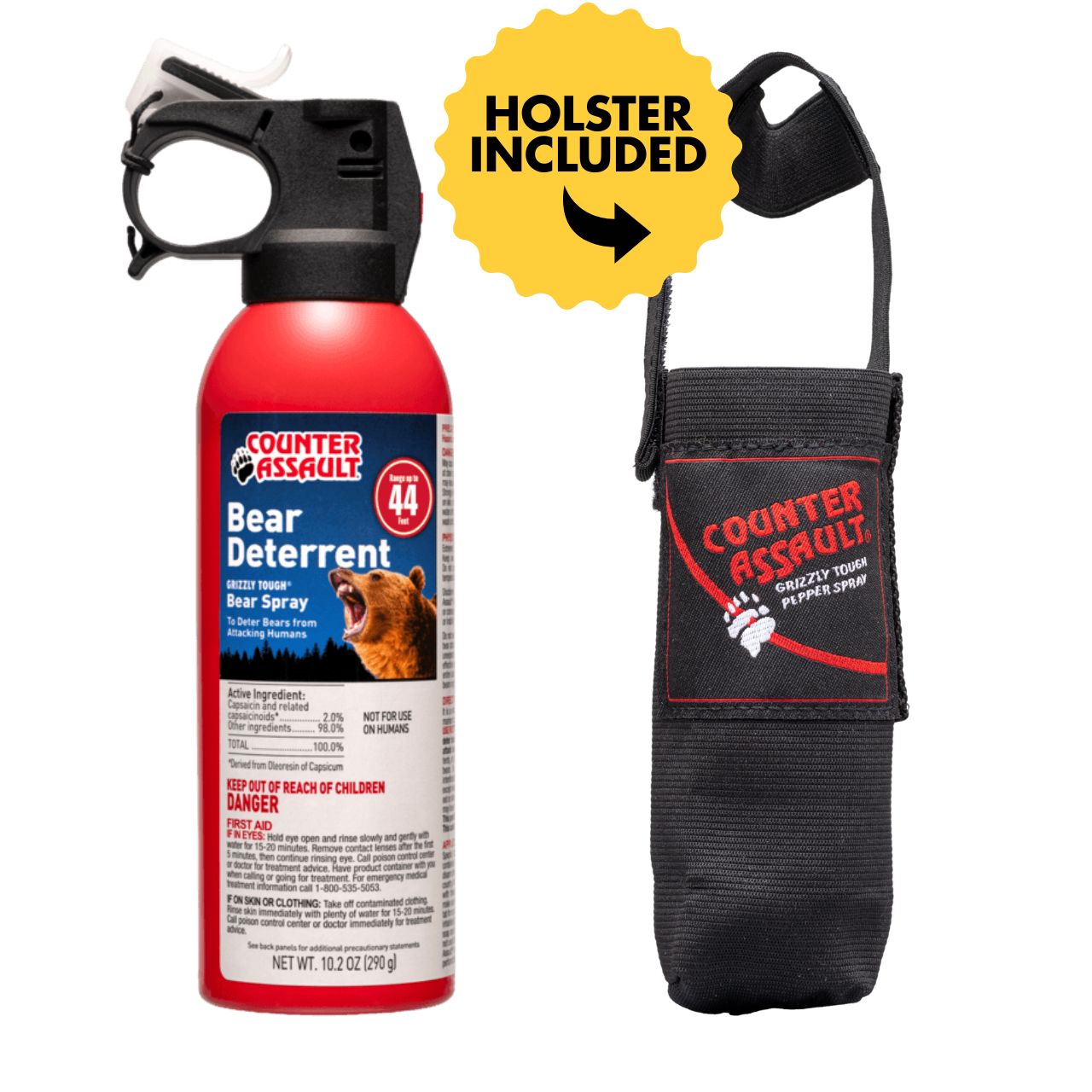
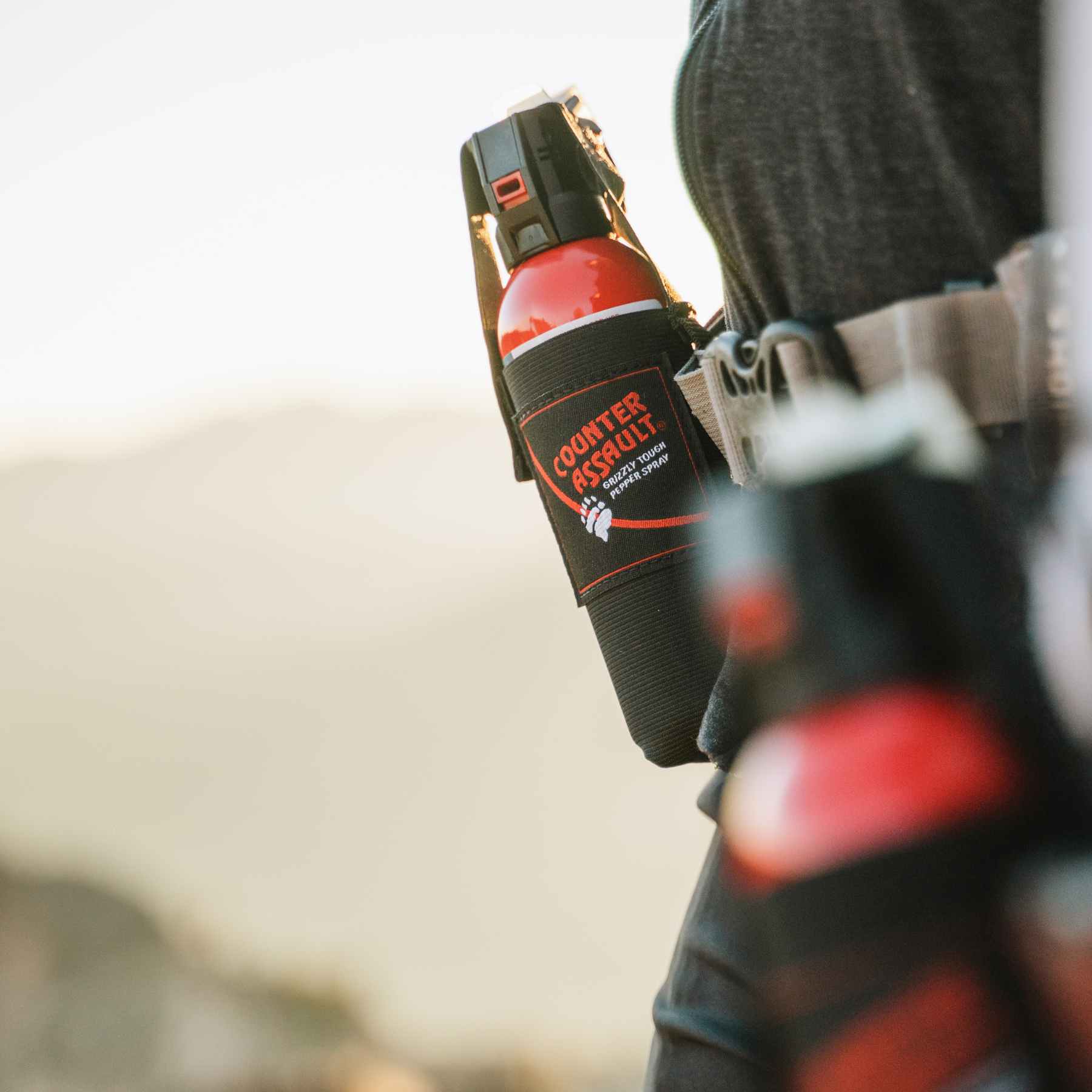
For daily use around cabins, campgrounds, trailheads, and neighborhood edges, bear spray carried on-body makes more sense than gear buried in a pack or left in a vehicle. Counter Assault makes a bear spray option with a holster, and the holster is the point here. If a deterrent is not immediately available, it does little good in a sudden encounter at close range.
Supporting gear should stay simple and field-usable:
- Light for low-visibility movement: A compact lantern or emergency light from LuminAID helps around camp, vehicles, and cabin sites where bears often show up after dark.
- Medical backup: A well-organized first aid kit from Adventure Medical Kits belongs in any vehicle, camp box, or daypack used in wildlife country.
- Emergency shelter and signaling: Compact survival items from Survive Outdoors Longer help if a delayed return leaves someone out after dark in active bear habitat.
People often ask about firearms. For the average hiker, camper, or homeowner, they are a poor primary plan for a fast black bear encounter. Under stress, access, distance, judgment, and shot placement all break down. People need simple tools, fast access, and enough standoff distance to leave safely without injuring the bear or another person.
Essential Bear Safety Debunking Myths and Using Deterrents
Across much of black bear country, the main safety problem is no longer a rare backcountry sighting. It is the growing number of routine encounters near trailheads, campgrounds, cabins, and neighborhood edges where bears have learned to use human spaces. That urban adaptation gap changes the job for hikers, campers, and residents. A population that looks stable on paper can still produce more close-range encounters in places where people are less prepared.

How to avoid an encounter
In the field, the same setup appears again and again. Thick cover, a blind bend, a creek loud enough to cover footfall, or a campsite with food odor drifting farther than people expect. Black bears usually want space, but they react fast when surprised or rewarded.
The prevention work is simple and practical:
- Hike in groups: Several people are easier for a bear to detect before anyone closes the distance.
- Make noise in thick cover: Talk, call out before bends, and stay audible near running water or dense brush.
- Use daylight to your advantage: Low light cuts visibility for both people and bears and shortens reaction time.
- Control food and scent: Store food, trash, coolers, and toiletries so a bear does not get an easy reward.
- Keep your distance: Photos are never worth pushing a bear off its travel route or food source.
A lot of these habits overlap with Leave No Trace principles, which help reduce food reward, habitat damage, and unnecessary wildlife pressure.
If a bear is spotted and is not committed to an approach, do not run. Face the bear, keep the voice steady, create space by backing away on an angle, and get spray ready early. Early access is what gives people options.
Proper bear spray use
Bear spray is for a bear that is charging, approaching aggressively, or showing behavior that can turn into a charge. It is not camp perimeter spray, and it is not a general repellent for gear or clothing. Misusing it creates false confidence and leaves no working plan when distance disappears fast.
Use follows a clear sequence:
- Remove the safety clip.
- Aim slightly downward toward the space in front of the animal.
- Deploy when the bear is within 30 to 60 feet, creating a cloud the animal must pass through.
- Continue spraying until the charge breaks off.
- If needed, direct the spray into the face if the animal keeps coming.
- Leave the area immediately once there is a safe opening.
Readers who want a more detailed refresher can review what you need to know about bear spray.
A short demonstration is often easier to remember than written instructions alone.
Common myths about bear deterrents
The most common bad assumption is that any defensive tool works equally well under stress. It does not. In a sudden black bear encounter, people lose time to surprise, poor footing, short distance, and fine motor breakdown. Spray gives a wider margin for error and a non-lethal outcome, which matters in crowded recreation areas and around homes where a missed shot can injure people, pets, or bystanders.
Two other myths cause repeat mistakes:
- “Bear spray does not work.” It works when it is legal to carry where you are, carried where the hand can reach it, and deployed before the bear is on top of you.
- “Wind makes it useless.” Wind affects any aerosol. Good positioning, early deployment, and enough spray volume still make it a practical field tool.
Carrying spray in a pack solves nothing. Accessibility is part of effectiveness.
Another useful field detail is canister size. Larger canisters generally provide more spray time, and that matters because people often fire in short bursts, reassess, then fire again if the bear keeps coming. Counter Assault's 10.2 oz bear spray is one example of a larger-format option that gives more margin in a fast encounter. The trade-off is simple. Bigger canisters carry more weight and take more belt space, but they are often easier to index quickly and harder to empty by accident when adrenaline is high.
The Future of Bear Management and Human Coexistence
The future of the American black bear population will not be decided by population numbers alone. It will be shaped by whether communities reduce attractants, whether agencies keep monitoring local conditions, and whether recreationists treat deterrent carry as normal preparedness rather than optional gear.

Shared responsibility is the real management model
Wildlife agencies can track trends and set policy. Scientists can identify habitat stress, movement patterns, and conflict zones. Local communities can secure trash, manage food rewards, and educate residents. Individual people still make the final difference on the trail, at camp, and at home.
The workable model is coexistence with limits. Bears need room, wild food, and freedom from reward-based habituation. People need practical tools and better habits. That combination protects both sides better than panic, neglect, or violence.
A non-lethal deterrent fits that model because it gives people a response option that does not rely on perfect marksmanship and does not treat every encounter as a lethal-force problem. In modern bear country, responsible carry is not alarmist. It is part of ethical recreation.
Frequently Asked Questions
Is black bear population growth always good news
Population growth can signal successful conservation. It can also widen the urban adaptation gap. A bear population can look stable on paper while conflict rises on the ground because more bears are feeding around neighborhoods, trailheads, campgrounds, and edge habitat near housing.
That is the primary safety question. Not just how many bears exist, but how often people and bears now cross paths.
What size bear spray canister matters in the field
Canister size affects the margin for error. In a fast encounter, extra spray volume can matter if the bear is closing, wind shifts, or the first burst is poorly placed.
Carry an EPA-registered bear spray canister sized for actual bear defense, not a small personal-defense spray marketed for people. In practice, larger wildlife-deterrent canisters are usually easier to aim under stress and give more usable spray time.
Can bear spray be used on animals other than bears
Yes, if the label allows that use. The product should be used as a wildlife deterrent and according to the manufacturer's instructions.
The main point is role clarity. Bear spray is built for stopping or redirecting an aggressive animal at close range. It is not a substitute for standard pepper spray intended for assaults by people.
Should homeowners in bear country carry spray too
Often, yes.
Plenty of trouble starts well off the trail. Bears show up near garbage storage, grills, bird feeders, fruit trees, chicken coops, sheds, and dog food left outside. In developed areas, the encounter window is often short. A person steps out a back door, rounds a garage corner, or heads to an outbuilding at dawn and the bear is already there.
Quick access matters at home just as much as it does in the field.
Is carrying spray enough by itself
No. Deterrent carry works best as one layer in a larger safety routine. Secure attractants, keep a clean camp, watch sightlines in thick cover, and keep kids and pets close where bears may be active.
Good habits prevent many encounters. A reachable deterrent gives an option when prevention fails.
For people who spend time where bears, mountain lions, or coyotes may be present, Counter Assault offers practical wildlife deterrent tools built around non-lethal safety. The right approach is simple. Carry a deterrent that can be reached fast, know how to deploy it, and pair it with habits that keep both people and wildlife out of trouble.